

 REQUEST INVITE
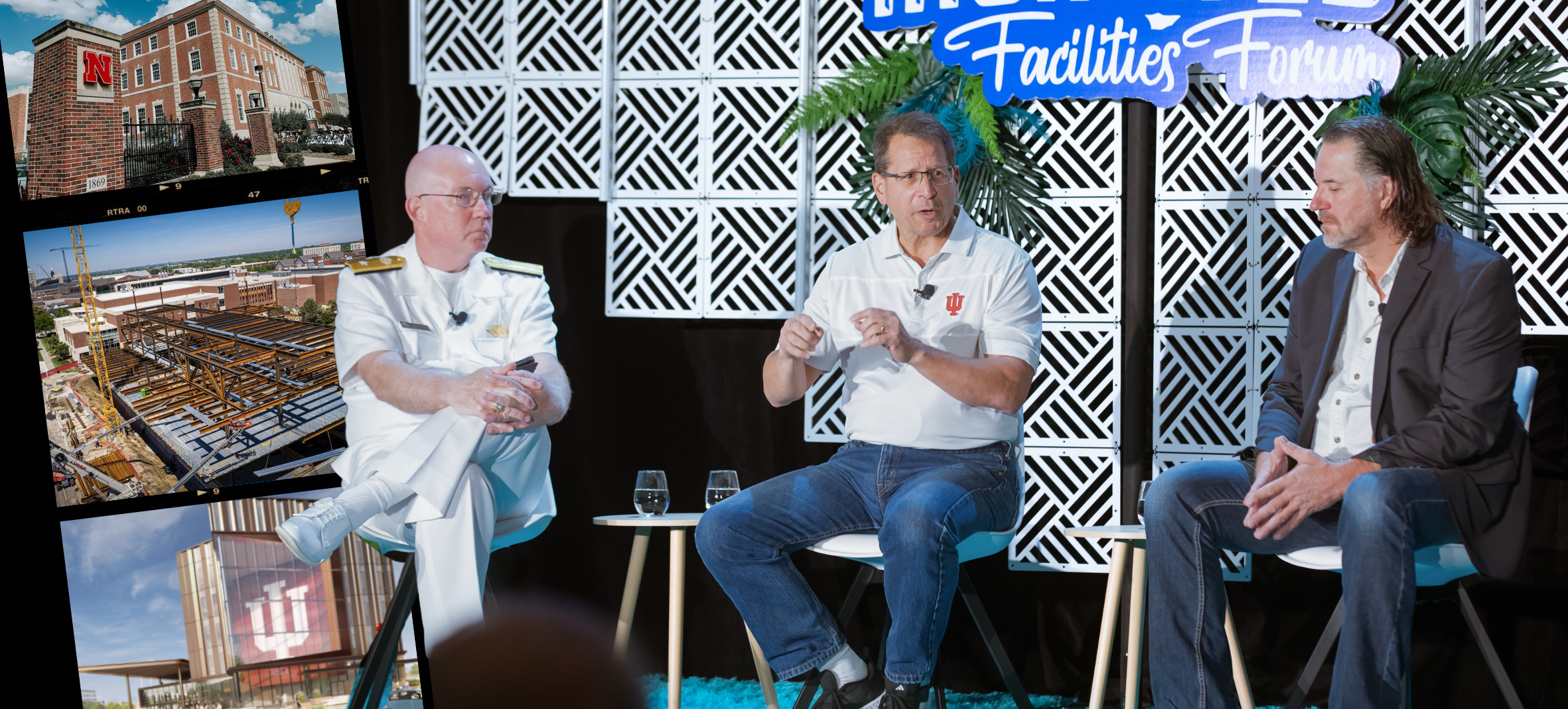
"By the time you interview somebody you want and get through the six-week HR process, they've already had five job offers and they're gone."
Jim Jackson, Associate Vice Chancellor of University Operations at the University of Nebraska–Lincoln, used that line at HEFF while talking about the reality of hiring in facilities right now.
Alongside John D'Angelo, Vice President of Capital Planning and Facilities at Indiana University, and John Shea, Chief Executive of Facilities and Infrastructure at the U.S. Merchant Marine Academy, the conversation focused on where the workforce problem is really starting to show up.
Not at the entry level. Not with the veterans nearing retirement. In the middle.
Supervisors. Foremen. Future leaders. The people facilities organizations are struggling hardest to keep.
Where the Middle Went
The 2008 recession carved out a generation of facilities leaders who should be moving into senior roles right now. Many left and never came back. COVID took another bite. And in markets where construction is booming, contractors can simply pay more.
"We used to be able to keep people just with benefits," Jackson said. "Now every private company is offering the same benefits, probably better."
It's not just salary that makes the math hard. D'Angelo pointed out that fringe benefit multipliers run between 24% and 36% on top of base compensation. That means every time a facilities organization wants to add one more carpenter or electrician, the business case has to account for far more than the wage. Private contractors carry the same burden now, but they have more flexibility in how they structure it.
Building the Front Door and the Back Door
At Indiana University, D'Angelo saw a gap at both ends of the apprenticeship pipeline. Young people were coming in without the basic skills to qualify for a helper position. And experienced journeymen had no structured way to pass on what they knew.
IU's solution was a pre-apprenticeship program, a one-year contract position, paid but not fully benefited, pairing incoming candidates with senior journeymen through a structured course book covering both technical and soft skills. Graduate the program and you qualify for the apprenticeship track.
The cost is relatively low. The unexpected benefit was what it did for the journeymen.
"The journeymen become so attached to their candidates' success," D'Angelo said. "It's really like a familial relationship."
At Nebraska, the approach was career ladders, built by directors and frontline trades together over four to five years, covering maintenance, grounds, custodial, utilities, and environmental health and safety. The ladders gave people a path on paper they could actually track.
One negotiated change with HR made a significant difference: posting a single position that could be filled at multiple levels depending on the candidate's skills. One electrician posting, filled as an apprentice or a journeyman from the same pool. No more running ten separate searches to fill one gap.
Supervisors can also approve raises within pre-approved ranges without going back through HR each time. Jackson was direct about why that matters.
"By the time you interview somebody you want and get through the six-week HR process, they've already had five job offers and they're gone."
Put Your Time Where It Actually Moves the Needle
Most leaders, D'Angelo argued, have been trained by HR to focus disproportionately on poor performers. The result: top performers don't get enough attention, middle performers start to drift, and the people at the bottom stay exactly where they are because they're getting all the energy.
Flip it. Invest in your top performers. Give them room, recognition, and growth. The middle tier watches and follows.
Technical skills can be taught. What can't be taught, D'Angelo argued, is service culture, that instinct to show up and care about the work. "That culture of wanting to be there? That has to come in the door with them."
When it works, the team starts to recruit itself. D'Angelo has had six direct reports go on to become VPs at other institutions. He doesn't frame that as a loss.
"I don't have any competition. If somebody recruits my people, they're paying the highest compliment to the team I've built."
The HR Problem Nobody Wants to Name Out Loud
An audience member put it directly: what do you do when your best people can't get promoted because they don't have the paper credentials HR requires?
D'Angelo's previous institution required a college degree for any supervisory role. Rather than fight the policy, he built around it, partnered with a local community college, found a way to use the existing employee education benefit to make attendance effectively free, and created a pathway for rising stars to get the credential they needed.
"I could have put the same energy into fighting the institution," he said. "But I probably wouldn't have had the same outcome."
Jackson's take was more direct. He noted that his HR department is still making decisions based on precedents from 158 years ago, when Nebraska first came on the map. The workforce, the market, and the moment have all changed. The precedents haven't.
"You have to say it out loud, and say it often: precedent does not matter. You need to treat every individual situation on its own terms."
Mentorship Without a System Is Just Good Intentions
Both Jackson and D'Angelo spent real time on mentorship, not as a concept, but as something that can actually be built into how an organization runs.
D'Angelo now holds a mandatory mentoring meeting with all his direct reports, not to offer himself as their mentor, but to give them tools to become mentors themselves. The ask at the end of every conversation is the same: pass it on.
For Jackson, mentorship is less about expertise and more about keeping people engaged through the stretches in higher ed that are genuinely hard: budget crises, enrollment pressure, and leadership instability.
"The people that scraped me up off the ground and said 'you can do this,'" he said, "those are my mentors." Including, he noted, the people who work for him.
People are watching everything you do, learning from the good and the bad. It's just the reality of leadership in facilities.
The Stakes
The scale of what these three are managing puts the people conversation in context.
Nebraska is carrying a structural deficit of $27.5 million and just absorbed all athletics venue management. IU is opening a new campus in Washington, D.C. while managing operations across multiple states. And Shea is navigating a $3 billion campus modernization on temporary concrete buildings thrown up during World War II that were never properly replaced, while competing for federal funding against a $30 billion air traffic control system replacement under the same department.
None of it gets done without people who are developed deliberately, given real pathways, and shown that the institution is actually invested in them.
"We can teach you how to fix things," Jackson said. "It's really tough to teach somebody to be humble and to be a good person."
Watch the full discussion below...

Posted by
Join us at HEFF!
An interactive retreat for facilities leaders at the nation's top colleges and universities.
Nov 8-10, 2026 | San Antonio, TX
Learn More
-May-04-2026-11-19-05-8005-AM.png)
-1.png)



Comments