

 REQUEST INVITE
Some institutions carry their history in their buildings.
At Virginia Tech, it lives in the people.
At HEFF 2025, Dwyn Taylor, Chief Facilities Officer at Virginia Tech, opened with a story that made that clear.
Taylor pointed to fellow speaker Mark Helms as an example. Helms spent 30 years working in Virginia Tech Facilities. His father worked there for 30 years. So did his grandfather.
Ninety years. One institution. One family.
When you change how an organization works, Taylor said, you have to consider the thoughts and philosophies of the people already there.
At Virginia Tech, those people were deeply committed. But over time, the organization had become siloed, horizontally flat, and spread thin.
Rethinking the Structure
At the time, the division was called the Division of Capital Planning, Infrastructure, and Facilities. Or, as Taylor put it, "a mouthful."
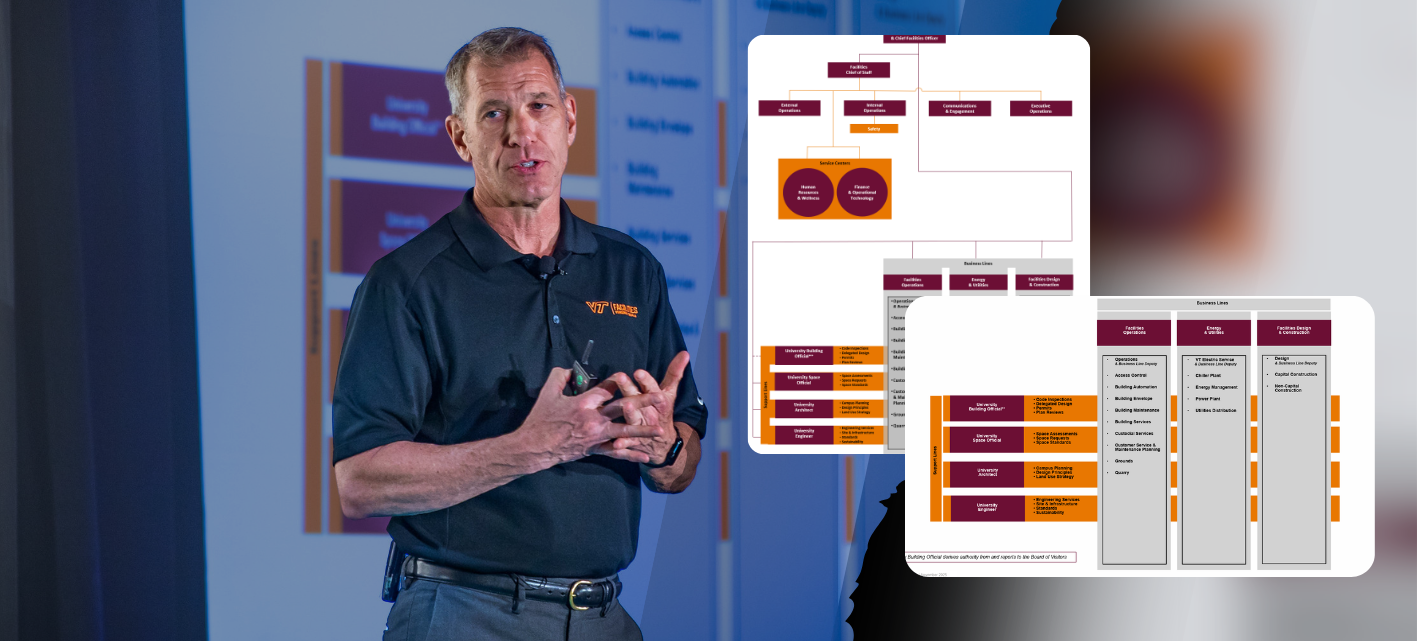
The org chart required an 11x17 sheet of paper to print, turned sideways, and was still barely legible.
So Taylor started with something simple.
He changed the name.
Out went the unwieldy title. In came Virginia Tech Facilities, TechFac for short. Two words. A brand. A starting point.
Along with the new name came a leadership philosophy centered on stewardship, caring, and serving. Taylor described Facilities employees as custodians of the university, responsible not just for managing physical assets, but for caring for the campus, the people who work there, and each other.
Then came the structure. Three core business lines, Facilities Operations, Energy and Utilities, and Facilities Design and Construction, with architecture, engineering, space, and building oversight working across all three. The matrix was designed to create more collaboration and interaction across functions.
But a new org chart wasn't going to change how people worked together on its own.
The 20-Minute Meeting
Every morning at 8:30, Facilities leaders stand for a 20-minute meeting. Nobody sits.
What happened yesterday. What occurred overnight. What's happening today. What's coming tomorrow and into the next week. Same format. Same expectation. Every single day.
Taylor called the standup instrumental in establishing the new culture and interaction across the organization. It also produced a practical result: fewer daily emails. People know they'll see each other every morning.
That daily meeting was part of a larger rhythm Taylor built deliberately. Weekly meetings looked several weeks ahead. Monthly planning sessions focused on long-term strategy. Every quarter, the division holds an all-hands for its 610-person team to celebrate achievements, recognize promotions and retirements, share professional development opportunities, and talk about where the organization is headed.
Scheduling those all-hands at 2:30 PM was intentional. Late enough to catch staff coming off day shift, early enough to reach those coming on. For the power plant team running 24/7, the team holds separate sessions so third-shift employees can hear what's happening as well.
Each semester, Virginia Tech invites leaders from across the university to meet with the Facilities team directly.
Different time horizons. Different conversations. One operating rhythm.
Making the Connections Clear
A new structure and a new cadence still weren't enough on their own.
Virginia Tech also spent significant time clarifying who was responsible for what and how different parts of the organization depended on each other.
During the first year under the new structure, monthly meetings regularly featured two leaders explaining their roles, their responsibilities, and where their work intersected with other teams. For an organization spanning operations, utilities, planning, design, construction, space, and engineering, those connections weren't always obvious.
Instead of assuming everyone understood them, Virginia Tech made them part of the conversation.
Connecting to the Bigger Picture
After nearly a year under the new structure, Taylor took the leadership team offsite twice to build their own strategic goals and connect them directly to Virginia Tech's broader university priorities.
Each leader now has short, mid, and long-term goals tracked and revisited every month.
Taylor described the results as "staggering," pointing in particular to the positive recognition of Facilities across Virginia Tech. He also said the changes have been "very, very well embraced."
His roadmap was straightforward: simplify the identity, establish a leadership philosophy, create a more collaborative structure, build a consistent operating cadence, clarify roles and responsibilities, and connect Facilities' goals to the university's strategic plan.
Through all of those changes, Taylor kept returning to the same ideas: stewardship, caring and serving. He described Facilities as custodians of the university, responsible for caring for the campus and one another while always serving with humility.
For facilities leaders leading organizations built on decades of history and institutional knowledge, that might be the most important place to start.

Posted by
Join us at HEFF!
An interactive retreat for facilities leaders at the nation's top colleges and universities.
Nov 8-10, 2026 | San Antonio, TX
Learn More
-May-04-2026-11-19-05-8005-AM.png)



Comments